
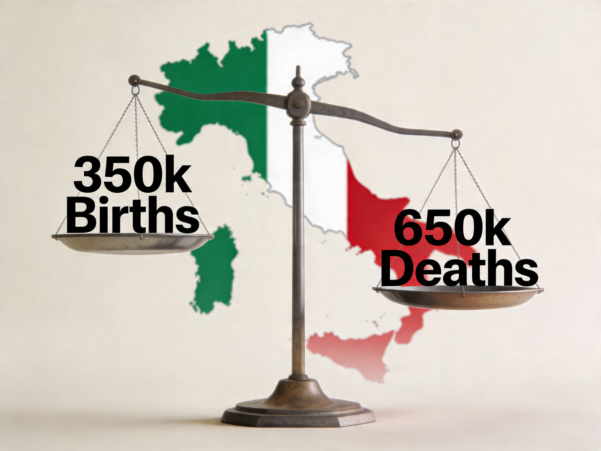
Last year, Italy, my country, recorded just 355,000 births in a population of about 59 million. That corresponds to a fertility rate of 1.14 children per woman of childbearing age, one of the lowest in Europe and indeed in the world. Around 650,000 Italians are now dying each year. You can see the direction of travel. It is catastrophic.
Italy, unfortunately, has a long history of below-replacement-level birth rates. Economic factors certainly matter, but a recent television programme on the station of the Italian bishops suggested that the crisis goes deeper. The same reasons almost certainly apply to other countries, including Ireland.
The programme began with interviews with Italian university students. Some said they would like children, but only after their thirties. Others were unsure if they would ever be able to afford a family. One young woman described having children as an “encumbrance”; another said having children had become “almost a luxury.” Several spoke of uncertainty, not only about their own prospects, but about the state of the world itself.
Vincenzo Bassi, president of the Federation of Catholic Family Associations in Europe (FAFCE), did not deny the economic pressures, but he argued that the central problem is more existential and social. He suggested there is too much disconnection between people. A society may offer tax breaks and incentives, but if men and women feel isolated, unsupported and mistrustful, policies alone will struggle to reverse the decline.
He said that demographic issues must be seen as part of any serious discussion of sustainable development. Children should not be viewed as a burden on public finances, but as part of a society’s human capital and future stability.
His remarks also carried a cultural and communal dimension. Too often, demographic decline is treated as something relevant only to families. Bassi reminds us that it affects everyone. A society without children is not simply poorer in numbers; it is weaker in continuity, solidarity and hope.
He suggested that birth rates might look different if they were measured not just across countries, but within regions where people are more connected to each other. Later, reflecting on examples from Trentino-Alto Adige, the region in the North-East of Italy which has the highest fertility rate, Bassi highlighted their family-friendly environments. “Families, when they are in a network, are more stable and more generative”, he claimed.
After Bassi, the programme turned to the medical dimension of delayed parenthood with gynaecologist Maurizio Guida. His intervention was brief but blunt. Social expectations may have changed, he said, but biology has not. “The social change does not coincide with a change in human physiology.” Many young adults now imagine their thirties as the natural time to begin thinking about children. Yet Guida warned that female fertility declines sharply after 35 and falls further after 42 or 43.
Taken together, Bassi and Guida offered a powerful diagnosis. Italy’s birth crisis is not only about the economy. It is about disconnection, weak communities, cultural uncertainty, and a society that often ignores the conditions in which family life can flourish. Unless those deeper realities are faced, the country will continue to drift into demographic decline.