
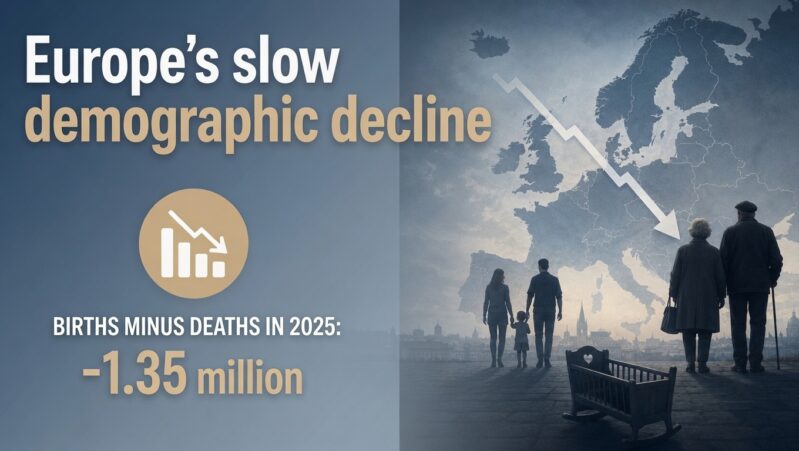
In 2025, there were 1.35 million more deaths than births in the EU. Despite this, the population has increased slightly but that is only because of immigration. That is according to the latest annual demographics report from the EU’s official statistic agency, Eurostat.
Eurostat figures show that births in 2025 were down a fifth compared with just ten years earlier. There were 3,459,677 births in 2025 and 4,329,512 in 2015. Deaths, by contrast, increased by 4.2pc in ten years to more than 4.8 million.
In 2025, there were 7.7 births per 1,000 people, while in 2015 this figure was 9.8. The death rate, by contrast, went from 10.4 per 1,000 to 10.7 in the same period.
“Natural change” (births minus deaths) has been negative every single year since 2012, meaning deaths have always outnumbered births since then.
The total fertility rate was 1.34 babies per woman (latest available figure from 2024), well below the replacement level which is about 2.1.
Only this week, Italy announced the lowest number of births since the end of World War II. Deaths outnumbered births by approximately 296,000.
The problem is not only that deaths outnumber births, but that the overall population is getting older. This is partly because the baby-boom generation, born roughly between 1945 and 1965, is now ageing together.
It is also because of increasing longevity. But in order to support a rapidly ageing population, older people are going to have to work for longer, and workers in general will have to be more productive. (What impact is AI going to have?)
Those aged under 15 went from 15.3pc to 14.4pc of the overall population, according to Eurostat. The aged 65 and over increased from 19.1pc in 2015 to 22pc in 2025.
The median age in the EU was 42.8 years in 2015, and it is now 44.9.
The mean age at first marriage has increased in all 20 EU countries for which data is available. Also, the mean age of mothers at the birth of their first child went from 28.9 in 2014 to 29.9 in 2024.
As in a vicious circle, fewer young people will inevitably produce fewer children, unless there is a dramatic cultural change in society.
The current EU population is being sustained by migration but, as fertility rates are now under replacement in most of the world, this is unlikely to happen for too long. Immigration cannot be the only solution to a shrinking population, as it involves its own issues.
Ireland is somehow still an exception, because it remained much more fertile than most European countries during the 1980s, when other major EU countries were going in the opposite direction, but by the mid-1990s it had moved much closer to the European pattern.
Nonetheless, in recent years Ireland has been getting closer to European levels. Its latest (2024) fertility rate is 1.47, according to Eurostat, well below replacement level.
Unlike most EU countries, Ireland continued to record a natural population increase in 2025, with 18,538 more births than deaths. However, this was almost half the natural increase of 35,957 recorded in 2015.
Europe’s demographic decline is not an unavoidable natural event but the result of decades of social choices. Immigration may postpone some of the consequences of low birth rates, but it cannot replace a society’s willingness to renew itself.