
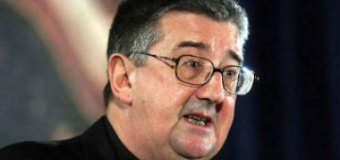
The Catholic Archbishop of Dublin, Diarmuid Martin, has stated that he’ll be casting a “No” vote in the upcoming marriage referendum, saying that he wanted to clear up any “confusion.”
Saying that his vote was one of “personal conviction”, Dr. Martin said that this was not only a religious question, but a change in the definition of civil marriage.
“You cannot take one article of the Constitution in isolation” he said. “Marriage is not simply about a wedding ceremony or about two people being in love with each other. Marriage, in the Constitution, is linked with the family and with a concept of family and to the mutuality of man and women which is the fundamental foundation for the family as it exists in the constitution today.”
Speaking to Dioscescan Communication Officers in Dublin, Dr Martin criticised politicians who argued in “broken gramophone-like quck sound-bites.”
“We should not forget that so much of what is cherished as good in secular society is, in fact, the fruit of Christian culture. Bishops regularly speak out on social issues and their comments are often – if not always – welcomed. Indeed they are often criticised for not taking positions on social issues. In the heated debate today this relevance of rational reflection inspired by religious belief is being reduced by some at times to a level of banality in which faith in Jesus Christ and his teaching is being placed on the level of belief in leprechauns” he said.
“I find it interesting” he added “that many of those supporting the yes campaign object to the use of religious language, but they are not shy in quoting Pope Francis in support of their arguments, although I feel that their knowledge of Pope Francis’ repertoire is somewhat restricted.”
“The fact that in the past the Church was dogmatic in its attempted imposition of its views rather than engage in rational societal debate, does not justify people today replacing “sound-bite-ism” for dogmatism as a way of avoiding rational debate.”
Dr Martin set out his reasons for Voting No, saying that “My position is that there is something irreplaceable in the fundamental complementarity between a man and a woman and that complementarity is not irrelevant to our understanding of the transmission and the nurturing of human life, within an intergenerational framework which contributes to the stability of society. I take up on what I said at (an) Iona Institute talk:
‘No person exists who is not the fruit of a male and a female. Even if it were possible to clone a child, that child would still bear the genetic imprint of a male and a female. An individual man or an individual woman cannot generate another human being just on their own.’
Genetic parentage is not irrelevant. We are all children of a male and a female and this must have relevance to our understanding of the way children should be nurtured and educated. Genetic make-up is a fundamental dimension of the intergenerational reality of family.”