

It seems family structure matters after all. An important new paper from the ESRI devotes a chapter to this question, and after controlling for factors like poverty, it nonetheless finds that being raised in a two parent household as distinct from a one parent household can confer certain advantages on children. The paper is called...

I had a very interesting debate about childcare on RTE’s Today with Sean O’Rourke yesterday. I was debating ex-Senator Jillian Van Turnhout, formerly of the Children’s Rights Alliance. I argued in favour of parental choice when it comes to child-minding. Jillian argued in favour of State-sponsored, State-funded, State-regulated ‘early education’. It was a clash of...

According to reports in the papers, in years to come it may be possible for scientists to create babies that will literally have no biological mothers. David Quinn discussed the ethical implications of this on The Pat Kenny Show on Newstalk on Friday. The item can be heard here. (Drag the bar at the top...
Press Release from the Iona Institute Plan for subsidised childcare is inherently unfair and unjust State must support choices of all parents not just day-care September 16, 2016– Reports that the State is considering a “radical new plan for subsidising childcare” are extremely concerning because if the State goes down this path, then it will...

Here in Ireland, there is a strong campaign against faith schools. Their ethos is under attack for not being ‘inclusive’ enough, as is their admissions policy. Meanwhile, the British Government has just heaped praise on Catholic schools and said more are to be built in order to meet public demand. The contrast with the situation...

A new opinion poll from the US lists some of the reasons why people abandon ‘organised religion’. These are the so-called ‘nones’, as in “my religion is ‘none’”. If a similar poll was done here, the reasons given for abandoning religion would be similar I am sure. The reasons range from the hypocrisy of some...

A recent paper from The Iona Institute shows that families today are massively penalised by the tax system compared with families in the past.
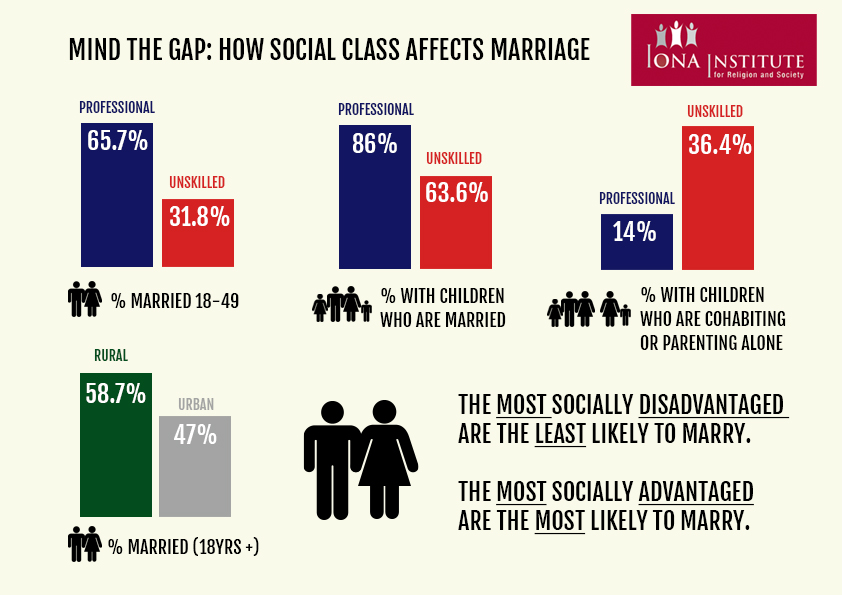
‘Mind the Gap’, a new report from The Iona Institute, shows how a person’s chances of marrying are hugely affected by the social class they are born into. The report shows that upper professional workers are more than twice as likely as unskilled workers to be married. The huge discrepancy shows that there are formidable...
‘Mind the Gap’, a new report from The Iona Institute, shows how a person’s chances of marrying are hugely affected by the social class they are born into. The report shows that upper professional workers are more than twice as likely as unskilled workers to be married. The huge discrepancy shows that there are formidable...
Writing in the Times of London today, Matt Ridley objects to people who object to gene editing on the basis that it is the slippery slope to eugenics. With all due respect to Mr Ridley, we are well down that slope already. The writer offers three reasons why gene editing will not lead to eugenics....