
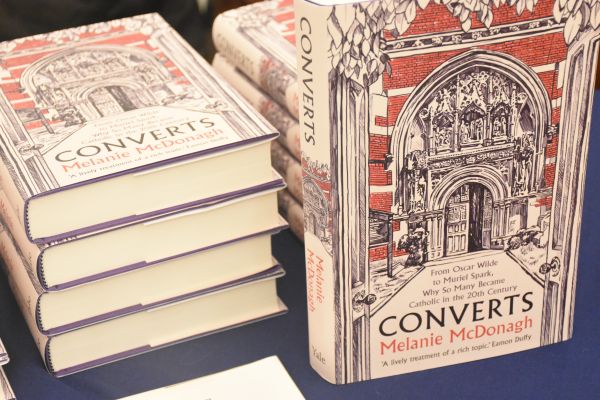
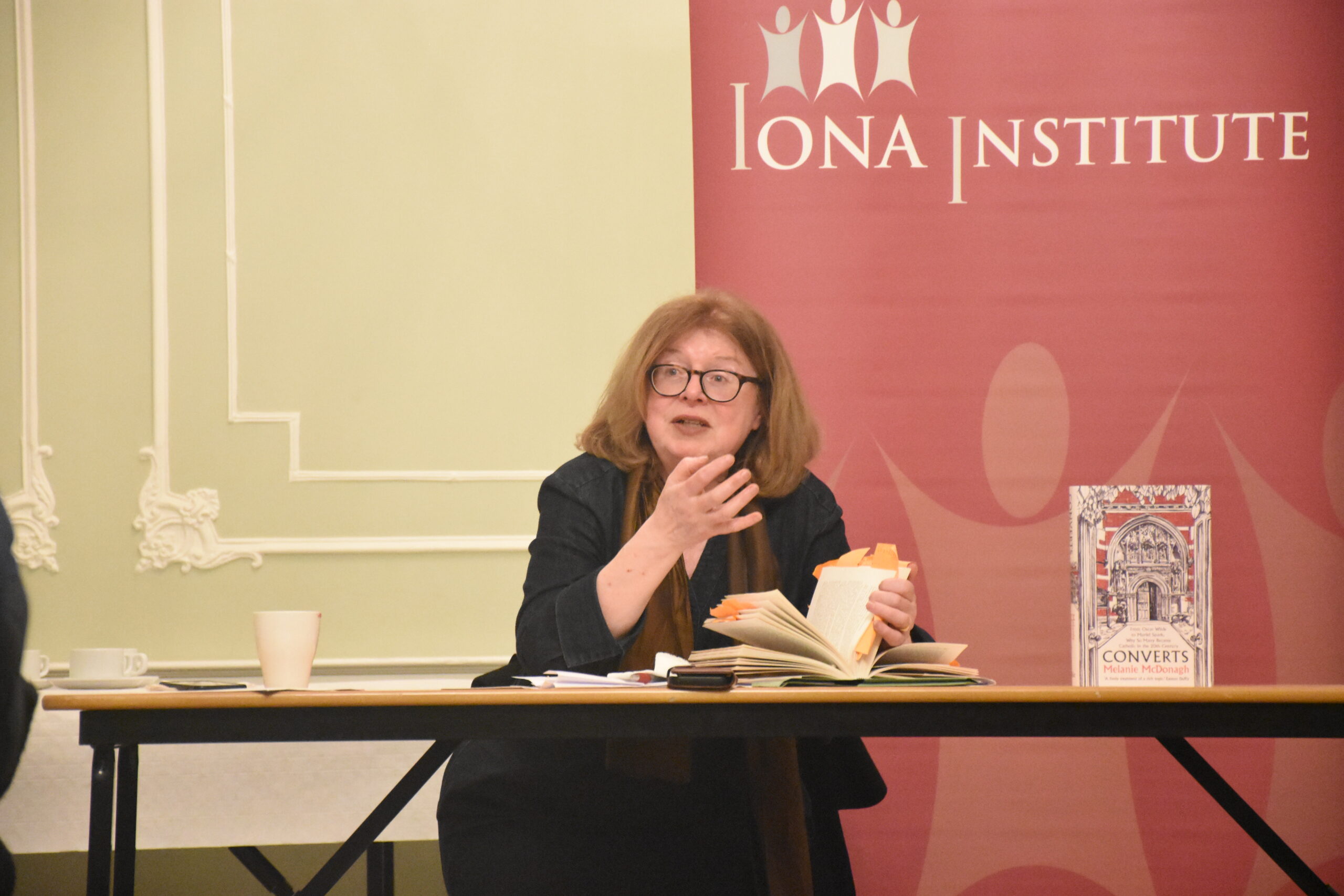
The Iona Institute was very pleased to host an outstanding talk by Melanie McDonagh (pictured below) on her widely reviewed new book, ‘Converts: From Oscar Wilde to Muriel Spark, Why So Many Became Catholic in the 20th Century’.
In front of a packed room, Melanie explained the social and religious conditions that led hundreds of thousands of English people to convert to Catholicism in the last century. It is a learned and entertaining overview of a particular moment in history and the larger-than-life characters who inhabited it. We think you will enjoy it immensely.
We are very grateful to the Knight of St Columbanus for letting us use their premises at Ely Place in Dublin for the event.
The talk can be watched on our YouTube channel here. (A summary of her talk is below the picture).
Summary of talk.
Core Thesis
The period between the 1890s and the Second Vatican Council (1960s) saw a significant intellectual and cultural movement toward Catholicism in England and Wales, involving approximately 600,000 converts. This trend was not merely an aesthetic pursuit but a profound reaction against the sterile secularism of the Victorian era and the dehumanising effects of mass industrialisation. The Church offered a “firm and hard” certainty in a world of political and economic flux.
Historical Vectors of Conversion
The Decadents of the 1890s
- Oscar Wilde: His conversion is framed as a lifelong attraction suppressed by family pressure and old-fashioned Protestant antipathy. Despite skepticism by some regarding his deathbed reception, evidence suggests he was conscious and consenting.
- Intellectual Milieu: The conversion of Wilde’s circle (Robbie Ross, Lord Alfred Douglas, John Gray) indicates how an entire intellectual current could sweep through a specific social milieu.
The Great War (1914–1918)
- Sacramental Necessity: Soldiers encountered Catholic piety in France and Flanders. The “heroic priest” model was provided by people like Ireland’s Father Willie Doyle).
- ‘The Charnel House’: The immediate prospect of death concentrated minds on the necessity of absolution and the “blessed fragment of viaticum.”
The Interwar Period
- Stability vs. Chaos: Figures like writers Graham Greene and Evelyn Waugh sought the authoritative character of the Church as a bulwark against the “general flux” of post-war Europe.
- Civilizational Defense: Waugh argued that the essential issue was no longer Protestantism vs. Catholicism, but Christianity vs. Chaos.
The Catholic Artist and the “Sign-Maker”
- Ontological Depth: Against George Orwell’s claim that orthodoxy ruins prose, the Catholic novel (Greene, Waugh, Spark) succeeded because it viewed characters “under the eye of God,” giving their actions eternal consequences.
- Sacramental Art: David Jones viewed the artist as a “sign-maker,” where the image is analogous to the sacrament—something that is both itself and something else (e.g., water as baptism).
Institutional Friction and the Vatican II Delta
- The ‘Bolshie’ Convert: Converts often maintained a “contractual” rather than “deferential” relationship with the clergy. Waugh and Greene famously resisted clerical dictation regarding their creative output.
- The ‘Liturgical Tsunami’: The Second Vatican Council (1962–1965) marked a sharp decline in conversion numbers. The abandonment of the Latin Mass and the “sacral character” of the liturgy traumatised many converts who had joined specifically for the Church’s perceived immutability.
- Statistical Collapse: Conversions peaked at nearly 16,000 annually on the cusp of the 1960s, falling to roughly 3,000 soon after.