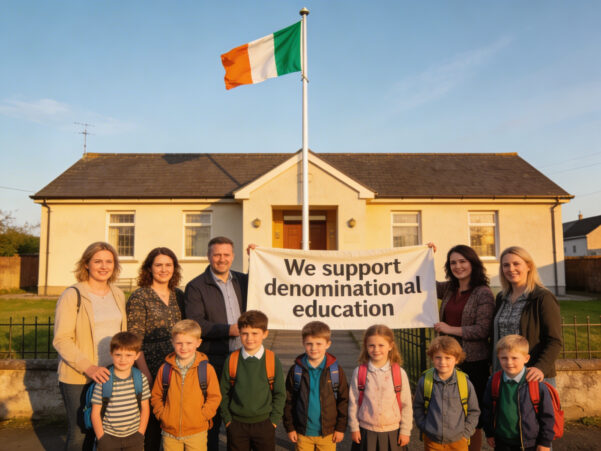
Some months back the Department of Education invited all parents with children aged 12 or below to state what kind of school they would like to send their children to. The most important question was whether they wanted their local school to be denominational or ‘multi-denominational’ (whatever that means). Forty percent of parents took part in the survey, and of those, 40pc said they would prefer a multi-denominational school (meaning 16pc of all parents). However, that means 60pc of those who took part do not want their children’s school to move away from a denominational ethos, a clear majority.
Some might be surprised at this given how far Mass attendance has fallen in the last few decades plus the effect of the scandals. But obviously a lot of people are still fond of denominational education, and the Department survey probably overestimated support for multi-denominational schools because those who are most motivated to change something are usually most inclined to take part in surveys like this.
We can also see from the results of the survey, which were released this week, that no county recorded a majority in favour of change. Even Wicklow, which had the highest support for change, was still below 50pc. In counties like Donegal and Longford, over 70pc want to keep their local school denominational.
In May, each school will receive its own individual results. But the parents who did not respond to the survey could easily change the picture once they find out their school might be a candidate for divestment. Generally speaking, parents have pushed back against divestment when it has been put before them, which is why so little has taken place.
According to the Department of Education’s own figures, currently 88.3pc of primary schools are Catholic, 5.5pc are multi-denominational, and the rest are under other religious patrons, mainly Church of Ireland.
This is the definition of ‘multi-denominational’, according to the Department: “A multi-denominational school is a school under a non-religious patron, where children learn about all faiths and belief systems through a multi-denominational programme. Examples include Community National Schools in the ETB sector, Educate Together schools and An Foras Pátrúnachta schools.”
In practice, the definition includes non-denominational schools, such as Educate Together, but these prefer to call themselves “equality-based schools”.
In its survey, the Department framed things in a way that was far from neutral. In its FAQ on patronage transfer, it stated: “To support Irish society changes, it is important to consider the option of making schools with a multi-denominational ethos more widely available, where the school community supports this. … There is demand for schools that don’t have a denominational/religious ethos at their core.”
That language plainly nudges people in a particular direction. It is not hard to see how this could influence responses. The problem is only made worse given that the term “multi-denominational” is clear. Therefore, what did respondents think they were answering?
Needless to say, much of the media coverage focused on the 40pc of respondents who want change. The Irish Times reported a “large number of parents” seeking a shift to multi-denominational education, while RTÉ led with “40pc of parents want multi-denominational schools”.
Those headlines are not false, but they do give a misleading sense of momentum. The Irish Independent went with a very different headline: ‘Majority of parents want denominational schools to maintain their ethos’.
In practice, when push comes to shove and particular schools are earmarked for divestment, the 60pc of parents who did not take part in the Department’s survey are likely to wake up and the current big majority of parents who back denominational education could easily grow and the Department will not get as much divestment as they want.