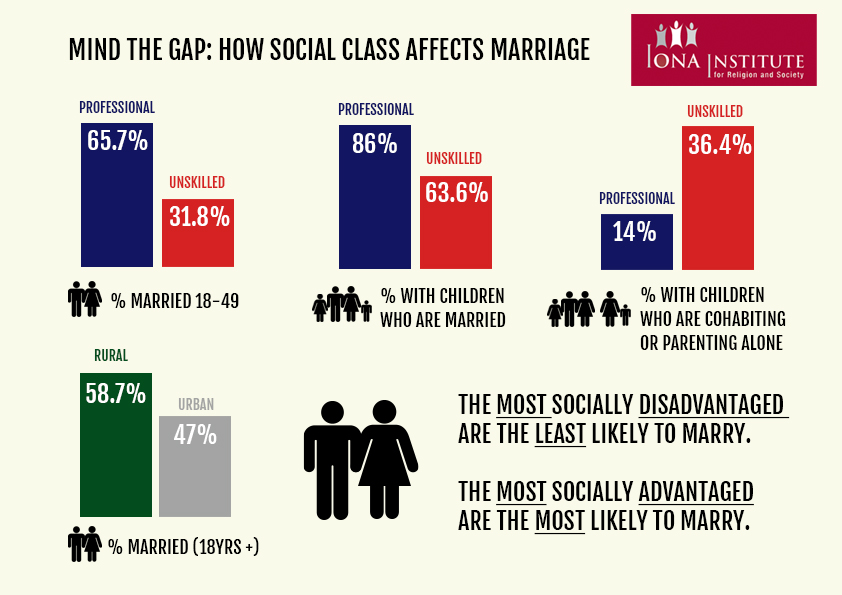
‘Mind the Gap’, a new report from The Iona Institute, shows how a person’s chances of marrying are hugely affected by the social class they are born into. The report shows that upper professional workers are more than twice as likely as unskilled workers to be married. The huge discrepancy shows that there are formidable...
If we pass the marriage referendum as the Government wants, it will have profound changes on how we view the family in our law. A major legal opinion commissioned by The Iona Institute examines this question. It shows that our ability to give preference to motherhood and fatherhood in Irish law will be severely and...
The Equality Authority is examining Section 37 of the Employment Equality Act which allows religious employers to protect their ethos. It has invited submissions from interested parties. Here is the submission of The Iona Institute.
The Iona Institute has published a major new report based on Census 2011 called ‘Marriage Breakdown and Family Structure in Ireland’. The report shows that between 1986 and 2011 there has been a 500 percent increase in the number of broken marriages in Ireland (affecting 247,000 adults in total).
Tax individualisation unfairly increases the pressure on parents of young children to be in paid employment, rather than care for children at home. The Iona Institute’s pre-Budget submission suggests some ways that this unfairness might be reduced. You can read the submission in full here.
The Constitutional Convention is to consider the issue of same-sex marriage at next month’s meeting. The Iona Institute has made a submission to the Convention, outlining the reasons why the definition of marriage should not be changed.
The Constitutional Convention is considering Article 41.2 which deals with women in the home. In our submission we argue that the provision should be amended, not deleted.
Our latest paper examines the status of surrogacy in European law and sets out the reasons why most European countries prohibit the practice. Chief among the reasons for prohibiting surrogacy is that it creates an automatic ambiguity about who the mother of the child really is. Is it the birth mother, the genetic mother or...
Professor Eamonn Conway of Mary Immaculate College in Limerick explains the threat posed to denominational education by proposals made in the Government’s Forum on Patronage and Pluralism and the need to protect the ethos of faith schools.
Our latest briefing note illustrates that, contrary to what has been alleged, policies protecting the distinctive ethos of denominational schools are fully consistent with both Irish and international human rights law.