
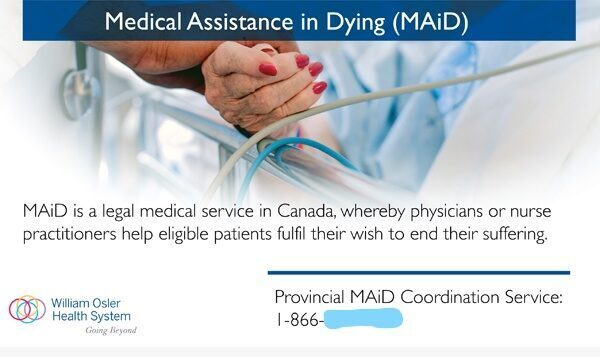
An expansion of assisted suicide in Quebec will result in it having one of the most permissive regimes in the world.
A so-called “right to die” will be given to people who have a “severe physical impairment resulting in a significant and persistent disability”. The new law will also allow people to undergo the procedure in outdoor spaces, including public parks.
In addition, it will also allow people with diagnosed Alzheimer’s disease or other forms of dementia to write advance directives requesting assisted suicide if their condition should decline further.
The updated law sailed through the province’s national assembly last week on a free vote, with just two Liberal MNAs voting against it, while a third abstained.
The new law also allows Quebecers to receive a doctor-assisted death in places other than hospitals, such as funeral homes and long-term care facilities. However, the practice cannot be promoted for commercial purposes and there cannot be any fees associated with receiving MAID.

Rachel Woods, an assistant secretary in the Department of Justice, was addressing the first meeting of the committee on Tuesday.
She said the courts have held that articles 40.1 and 40.3, together, “commit the State to valuing equally the life of all persons”.
“The European Convention on Human Rights provides that everyone’s right to life shall be protected by law. The obligation to safeguard the right to life is why, in the absence of any legal framework to allow for it, the state has, and must have, laws to protect life,” she said.
“The offence of assisting suicide . . . stems from the time when suicide and attempted suicide were criminal offences at common law in Ireland. This meant that any person who was an accessory to a suicide or an attempted suicide could also be tried as if they were a principal offender. “
“While suicide has been decriminalised, the offence of assisting suicide was retained and put on statutory footing. The offence has a maximum penalty of 14 years imprisonment on conviction on indictment.

A leading journalist has said that the Hate Speech Bill currently before the Seanad is a “dangerous and draconian” piece of legislation under which “anyone could be found guilty” because “hate is criminalised without being defined”.
Dr Helen Joyce, formerly Finance Editor and International Editor with The Economist, addressed a briefing with barrister Lorcan Price, which outlined concerns about the how the Bill “may operate, against a background of ‘cancel culture’, to curtail legitimate freedom of expression on a range of issues — including on gender-related controversies”.
“When a crime has no definition, anyone can be found guilty. And that’s what’s going to happen if this bill becomes law, because it criminalises ‘hate’ without defining it,” Dr Joyce said.
She shared a list of statements with Gript media that she said could be considered crimes if the hate speech bill went through, including “men can’t be women,” and “children should not be given puberty blockers or cross-sex hormones.’
Regarding the gender identity protections in the hate crime bill, Joyce said that “identifying” as a woman was “an entirely male experience.”
“I can’t ‘feel’ like I am a woman, or I was ‘meant to’ be a woman – I just am a woman,” she said. “That’s not hate, it’s just true. And in some circumstances it’s essential to say it.”

Abortions in Scotland rose by nearly a fifth (19%) between 2021 and 2022, when there were 16,584 abortions in total.
The figures were revealed last week by Public Health Scotland and were labelled a “disastrous” death toll by the Society for the Protection of the Unborn Child (SPUC).
In 2022, chromosomal conditions were listed 112 times as a reason for abortion in Scotland, including Down’s Syndrome and Edwards’ Syndrome. Nervous system conditions such as spina bifida were listed 54 times.
Such abortions are classified under Ground E, the second most common Statutory Ground, citing a substantial risk that the child born would suffer from physical or mental conditions.
While the rate of Ground E abortions has been relatively minor and constant in recent years – representing 1.6% of abortions in Scotland in 2022 – the listing of Down’s Syndrome as a reason to abort is at a five-year high at 59.
UK law currently allows babies with Down’s Syndrome to be aborted up to birth. Campaigner Heidi Crowter is challenging the law.

Retired Cork GP Dr Sinead Duggan touted the legislative ‘safeguards’ contained in the 2021 law.
“New Zealand’s legislation is very rigorous”, she claimed, “you have to have capacity [to make the choice]. You have to have inevitable death within a short period of time. You can’t approach the patient about it, the patient has to bring up the subject with their doctor – there are a lot of very strict criteria.
“They get a psychiatrist to see if there are mental health issues involved.” However, the law does not require anyone to see a psychiatrist.
Among the legislative requirements, the person must be aged 18 years or over, must suffer from a terminal illness that is likely to end their life within six months, must be in an advanced state of irreversible physical decline and must experience ‘unbearable suffering’.

A woman has been jailed for 14 months for illegally inducing an abortion in the eighth month of per pregnancy, using drugs supplied by an abortion provider that are meant for use in the first ten weeks of pregnancy.
Pro-life advocates have frequently criticised the “pills by post” scheme for being open to abuse, risking the lives of women who may take the drugs over medically prescribed limits, or who may be forced to ingest them by abusive partners.
Carla Foster, 44, received the abortion-inducing drugs following a remote consultation where she concealed the extent of her unborn child’s gestation.
Based on the information she provided over the phone, the British Pregnancy Advisory Service (BPAS) estimated she was seven weeks pregnant. However, Stoke-on-Trent Crown Court heard the woman was between 32-34 weeks pregnant.
On 11 May 2020, having taken the drugs, an emergency call was made saying she was in labour.
The baby was born not breathing during the phonecall and was confirmed dead about 45 minutes later.
The mother has admitted to being haunted by remorse, nightmares and flashbacks to her dead child’s face.
Sentencing, judge Mr Justice Edward Pepperall said it was a “tragic” case, adding that if she had pleaded guilty earlier he may have been able to consider suspending her jail sentence.

A proposed amendment to a bill in California would classify parents who refuse to affirm their child’s preferred gender as ‘abusive’ and could result in revoked custody.
AB957, proposed by Democratic Assembly member Lori Wilson and state Senator Scott Wiener, amends the state Family Code which addresses the ‘health, safety, and welfare of the child’ in every household.
If passed, the law could see children pulled from their parents’ home if their family members have what the state deems anti-LGBTQ+ ideals.
Rep. Wilson – who has a transgender son – said during a recent meeting that she believes parents supporting their child’s gender is in the ‘best interests’ of the kid.
‘We should be affirming our children in every possible way,’ she said of the proposed last-minute addition to the Family Code bill.
A challenge to the ban on abortion in Poland when a child has a disability was struck down by the European Court of Human Rights (ECHR) last week.
Without ruling on the merits, the Court said that the applicants could not personally claim to be “victims” of the ban as they were not pregnant or expecting a child with a disability.
At issue was a decision of the Polish Constitutional Court of October 22, 2020 which ruled that a long-standing law allowing “eugenic abortion”, or abortion when a foetus is “malformed”, was contrary to the constitutional principles of respect for human life and dignity, which is endowed to every human being from before birth.
The decision was welcomed by the pro-life European Centre for Law and Justice who called it a significant defeat of pro-abortion lobby groups from all over the world.
Canada’s legalisation of euthanasia should be a warning sign for other countries as people are offered help to die if they do not have adequate access to social supports, MPs in the House of Commons have been told.
The country has a “very aggressive medical delivery system of euthanasia”, a parliamentary committee heard as it listened to experts on the issue.
In what was described as a “very disturbing societal norm”, Dr Scott Kim, told MPs: “The law itself says this doesn’t have to be last resort, which means that a person could genuinely lack access to disability services, to outpatient psychiatric treatment, which is common in Canada. Those people would still qualify.”
Canadian Professor Trudo Lemmens said he had been a supporter of initial legislation but it has become a “form of harm reduction”.
“I would say Canada is a warning sign for countries that contemplate legalising medical assistance in dying or assisted suicide and euthanasia.”

A growing ideological polarization between men and women spells bad news for marriage as young men are moving slightly right while young women move strongly left and fewer Americans are willing to date or marry across the political aisle.
That’s according to Brad Wilcox of the Institute of Family Studies.
In an article in the Atlantic magazine, he says “Liberal women & conservative men who want to marry face a particular challenge:… there are only 0.6 single liberal young men for each single liberal young woman; likewise, only 0.5 single conservative young women exist for every conservative young man.”
“About 1 in 5 young single adults will have to put a ring on someone outside their ideological tribe—a consequence of the fact that far more single conservative men than conservative single women now exist, as well as far more single liberal women than single liberal men.”
“The sobering future for marriage and family life in America is that greater political polarisation spells trouble for already anemic rates of dating, mating, and marrying,”