
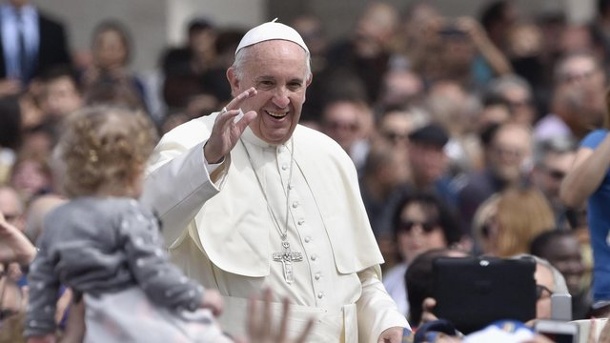
The death penalty is now no longer admissible under any circumstances after a change to the Catechism of the Catholic Church was decided by Pope Francis.
“The death penalty is inadmissible because it is an attack on the inviolability and dignity of the person,” reads the Catechism of the Catholic Church now, with the addition that the Church “works with determination for its abolition worldwide.”
This is a departure from what the document, approved under Pope John Paul II in 1992, says on the matter: “Assuming that the guilty party’s identity and responsibility have been fully determined, the traditional teaching of the Church does not exclude recourse to the death penalty, if this is the only possible way of effectively defending human lives against the unjust aggressor.”
As it’s been re-written, the Catechism now says that “more effective systems of detention have been developed, which ensure the due protection of citizens but, at the same time, do not definitively deprive the guilty of the possibility of redemption.”
It’s for this reason, and “in light of the Gospel,” that the Church teaches, according to Pope Francis, that the practice is now inadmissible.

Hundreds of doctors have staged anti-abortion protests in Argentina as an abortion rights bill moves toward a vote in the Senate next week. Some have demonstrated while carrying models of unborn babies and waving signs saying: “I’m a doctor, not a murderer.” At one recent protest, they laid white medical coats on the ground outside the presidential palace.
While the Doctors for Life activist group claims about 1,000 members, its protests are feeding a debate in the profession as a whole about the move to legalize abortions for any reason in the first 14 weeks of pregnancy.
Leaders of the Argentina Medical Society have endorsed the bill, which has already passed the lower house of Parliament. But the Academy of Medicine vehemently rejects the legislation. The academy issued a statement that human life begins at conception and “to destroy a human embryo means impeding the birth of a human being.”
“Nothing good can come when society chooses death as a solution,” it said.
The measure only narrowly passed in the Chamber of Deputies on June 14 after a long campaign by hundreds of feminist and left-wing groups. Its advance appears to have galvanized opponents, religious and otherwise, to mobilize public protests ahead of a Senate vote tentatively set for Aug. 8. President Mauricio Macri has said he will sign the measure if it passes, despite opposing abortion.
Pope Francis this year denounced abortion as the “white glove” equivalent of the Nazi-era eugenics program and urged families “to accept the children that God gives them,” but he has not spoken publicly on the debate in Argentina.
Christians in India are treated as “terrorists” by the government, according to a group of Catholic bishops, who claim it uses its Anti-Terrorist Squad (ATS) to investigate Christian institutions, Catholic news agency UCAN reports.
Nine bishops from the north-eastern state of Jharkhand met with the state governor, Draupadi Murmu, in a bid to stop what they called “government harassment”.
“We are now treated as terrorists and officials of the ATS are after us as if we are involved in terrorist activities,” Auxiliary Bishop Telesphore Bilung of Ranchi, Jharkhand’s capital, told UCAN.
Over the past few months, several Christian organisations have been investigated and requested to produce their financial details within 24 hours, while “church people” have been arrested on “trumped-up charges”, the bishop said.
The bishops’ claims however were dismissed by state police spokesperson R.K. Mallick who dubbed them “absurd”.
A prominent pastor and academic has launched an appeal to Church leaders in Australia to prepare faithful Christians for a rising tide of hostility and persecution. Writing for The Gospel Coalition, Campbell Markham said that in Australia right now freedom of religion, conscience, and assembly are considered natural rights, but if the Government “grants” religious freedom, then “natural rights will be transmogrified into state rights.” He then predicted that such state-granted rights will be steadily restricted and repealed over time.
“I expect, within the remainder of my lifetime, that Christians will be legally restricted in their ability to speak out and live out their faith in the public sphere. Abortion centre “exclusion zones” and recent anti-discrimination actions are the thin end of the wedge here.
”I expect, within the remainder of my lifetime, that Christians will be forbidden to educate their children the way they want to. . . . I expect, within the remainder of my lifetime, that professing Christians will begin to be barred from such professions as law, education, healthcare, the academy, and the civil service.”
He then addressed a plea to directly to Church leaders, parents and anyone with influence over Christian young people: “Prepare them for hardship and persecution.”
https://au.thegospelcoalition.org/article/australian-church-leaders-prepare-people-persecution/
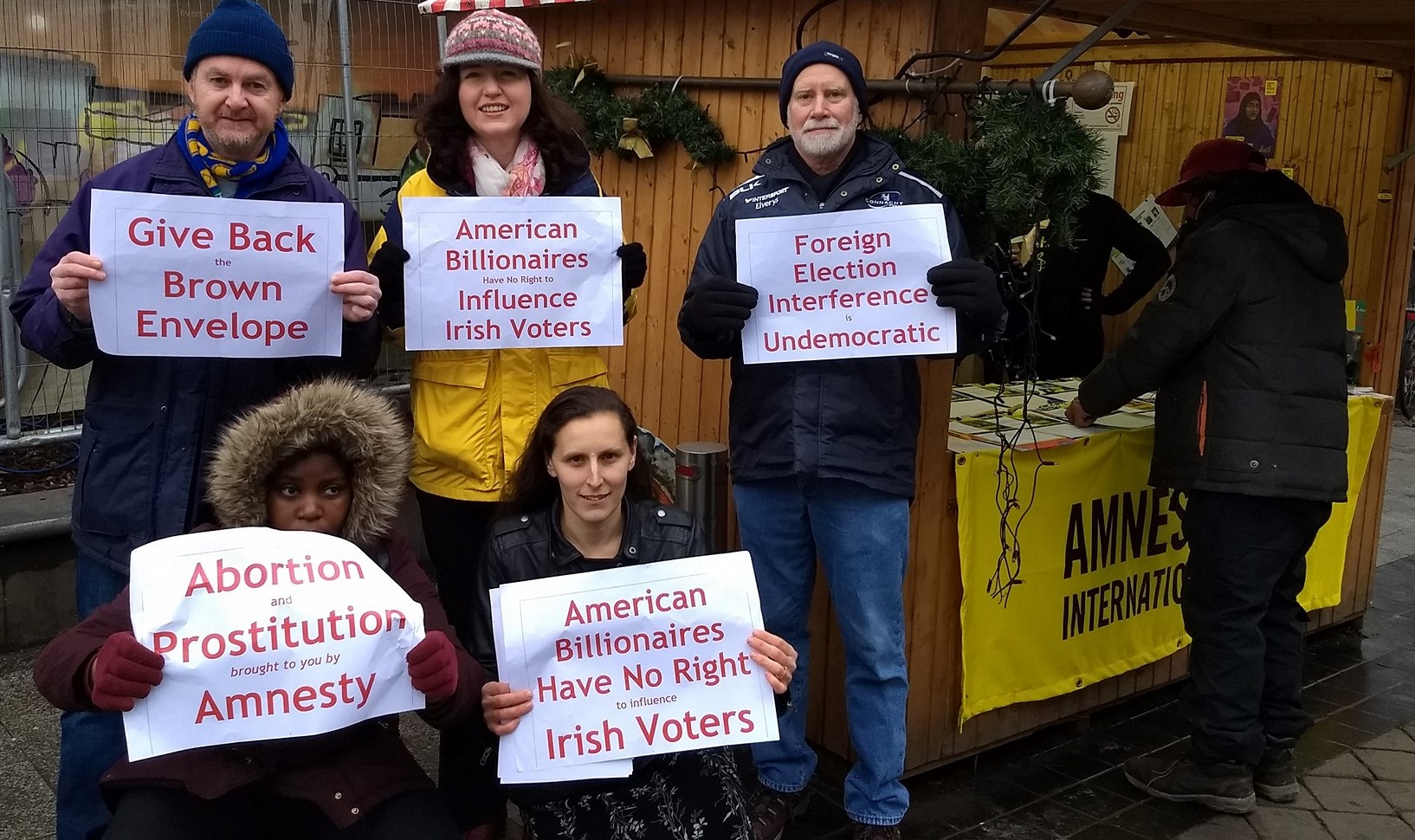
An investigation by an election watchdog against Amnesty Ireland’s receipt of a massive foreign donation to campaign for an abortion referendum was ‘procedurally flawed’, the High Court was told yesterday. The investigation was conducted by the Standards in Public Office Commission (SIPO) last year and they had concluded it by ordering Amnesty to pay back the monies to the American billionaire donor, George Soros’ Open Society Foundation. Amnesty, however, argued that the money was not used for its referendum campaign for repeal of the Eighth Amendment as the referendum had not yet been called at the time the donation was made. When OSF denied last December that it told SIPO the grant was for ‘political purposes’, nonetheless they said: “The grant in question was to fund the continuation of Amnesty’s ‘My body My Rights’ campaign, which seeks to mobilise support for a repeal of the 8th Amendment to the Irish Constitution. . .”
A letter read in court by counsel for Sipo Tuesday said: “Following careful consideration of the complaints made by your client, the Commission has concluded that the process leading to the adoption of the decision communicated in a letter of 17 November 2017 was procedurally flawed” and “considers it appropriate” to consent to the Court’s order to quash the original decision.
The letter also addressed a press release issued by Sipo in December 2017, which Amnesty had raised in its action. Contradicting the Commission’s previous claims, the letter says: “The Commission confirms that at no point did the OSF (Open Society Foundation) advise the Commission that the donation was for political purposes within the meaning of the Electoral Act 1997.”
Sipo also agreed to make a contribution to Amnesty’s legal costs.
The UK Supreme Court has decided that patients with permanent vegetative state (PVS) and minimally conscious state (MCS) can now be effectively starved and dehydrated to death if the medical staff and relatives agree that this is in their ‘best interests’.
People with PVS (awake but not aware) and MCS (awake but only intermittently or partially aware) can breathe without ventilators but need to have food and fluids by tube (CANH).
These patients are not imminently dying and with good care can live for many years. Some even regain awareness. But if tubal feeding is withdrawn, then they will die from dehydration and starvation within two or three weeks.
Until last year all cases of PVS and MCS have had to go to the Court of Protection before CANH could be withdrawn. Under the old rules, only about 100 applications to stop tube feeding have been made in more than 20 years, since the Tony Bland case created the precedent in 1993. But this could now hugely increase.
In two cases last year (known as M and Y) the High Court ruled that if the relatives and medical staff agreed that withdrawal of CANH was in the patient’s ‘best interests’ then the court need not be involved. The Official Solicitor appealed this decision to the Supreme Court in a hearing in February. The Supreme Court issued its judgement Monday effectively upholding the decision of the High Court.

One of the UK’s most famous divorce lawyers has urged schools to help young people prepare for marriage.
Baroness Shackleton of Belgravia wants schools to help pupils view marriage as “the most important decision they make”. She said it must be understood not simply as romance, but as the context for bearing and raising children: “It’s a practical arrangement . . . which has to survive to rear children.”
She added: “It’s the children who are the very sad losers when parents are selfish and decide their own desires override those of their family.”
To avoid the “untold grief” of separations, she hoped that research on the best marriages would be introduced in schools, and that they would devote “just a little time to get students to focus on what is the most important decision they make, which is basically who they breed with”.

A Canadian man legally changed his gender to female so he could take advantage of better car insurance rates offered to women and save up nearly $1,100 Canadian Dollars, a report said. The man told Canadian Broadcaster, CBC News, that he was given a quote of $4,500 Canadian Dollars but was told his yearly bill would be around $1,100 less if he was a woman. Men under the age of 25 pay higher rates as insurers deem them a higher risk than women of the same age.
“I was pretty angry about that and I didn’t feel like getting screwed over any more,” the man said, adding that he asked the insurers to change his gender on the insurance policy but they refused.
To take advantage of the lower rates and “beat the system”, David had to legally change his gender on a birth certificate. To do so, he had to acquire a note from the doctor acknowledging his identification as a woman before he could proceed with the change.
“It was pretty simple. I just basically asked for it and told them that I identify as a woman, or I’d like to identify as a woman, and he wrote me the letter I wanted.”
Just weeks after submitting all the documentation, David was legally a female and subject to lower premium rates for the insurance. “I was quite shocked, but I was also relieved,” he said. “I felt like I beat the system. I felt like I won.”
He fully recognises the absurdity of the situation. “I’m a man, 100 percent. Legally, I’m a woman,” he said, noting that he will be saving around $91 Canadian Dollars per month. “I did it for cheaper car insurance.”
Christians should subvert the closed shop of the modern world with the unbounded generosity of God, the Archbishop of Tuam, Michael Neary has said. Speaking to pilgrims on Croagh Patrick for the annual Reek Sunday climb, he said that many feel they are strangers in a strange land, but pilgrimages, “provide an opportunity to take stock but also a time to discover new heart.”
He said that just as in the Roman Empire, the Church is again small, peripheral, suspect and despised, and it faces a brilliant, glittering and self-assured civilisation. However, that civilisation is consumed by short and medium-term goals where in politics, business, entertainment and sport careers are made, unmade or simply just die unnoticed, all at a tremendous pace. Even the educational system, he said, “makes fewer and fewer bones about the socio-economic goals of learning and there is less and less value placed on knowledge for its own sake and wisdom as an end in education.”
To counter this, he said the Church must go to whatever avenues remain open to it.
“Just as once we were consulted and heard in the most powerful circles, now we must get used to preaching on street corners and making the Gospel heard over the incessant hubbub of the public square,” he said.
“If we have one mission it is surely to subvert the closed shop that is the modern, western world view and to startle that careful, calculating world with the unaccounting largesse, the generosity, the hospitality of God.”
According to a report by Rwanda’s pro-government KT Press, more than 8,000 churches have been closed by the Government for failing to meet strict new requirements laid down at the beginning of the year. Many see the closures as part of an effort by the government to assert an aggressive secular stance.
Rwandans’ right to religious freedom is granted under article 37 of the 2003 constitution, which was amended in 2015. However, there has been a marked increase in secularism in the government: They no longer allow prayer meetings in government institutions, which used to be very common. Words referring to the Christian faith have been removed from the preamble of the Constitution. During the commemoration of the genocide, neither pastors nor priests (who used to play a prominent role in past commemoration events), can speak or preach any more, unless the event is organised by a church.
There is a high level of fear among church leaders. Shortly after the new requirements began to be implemented, officials arrested six pastors accused of plotting to defy the government orders. Although the pastors have since been released, a senior church leader explained that the arrest served as a stern warning to others to not resist the move.