
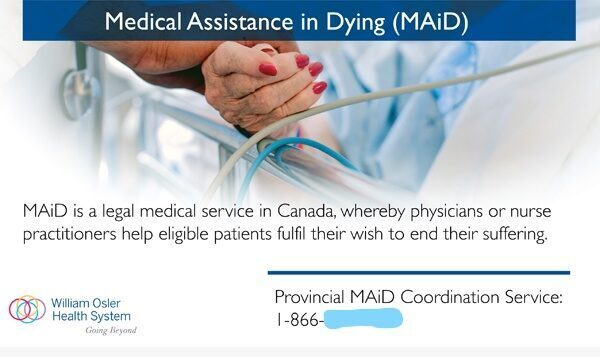
A doctor has been formally cautioned in Canda for assessing a patient for euthanasia outside a coffee and doughnut shop and meeting him at the same location six months later to drive him to where he ended his life.
‘Assisted dying’ was legalised in Canada in 2016 under strict criteria, but the rules governing it were greatly loosened in 2021 to also include those not terminally ill. More than 76,000 deaths have been recorded up to the end of 2024.
The case of Thomas Dillon, 45, who suffered from Crohn’s disease and depression, came to light after an official review by the College of Physicians and Surgeons of Ontario concluded that the administering doctor violated professional boundaries, with some of his actions potentially bordering on coercion.

Poland’s fertility rate, already one of the lowest in the world, fell to a new record low of 1.07 in 2025, deepening concerns over the country’s shrinking and ageing population. Without immigration, this fertility rate means a country’s population will drop roughly by half every generation.
In a new publication of demographic data for 2025, Statistics Poland (GUS) revealed that the fertility rate – meaning the average number of children that are born to a woman over her lifetime – declined to 1.068 last year, from 1.099 in 2024.
The figure is just over half the level recorded in 1990 (1.991).

There were 18,783 abortions in Scotland in 2025, the highest on record, Public Health Scotland announced on Tuesday.
Provisionally quarterly figures previously showed there were 45,091 births in the same year which means more than one in four recorded pregnancies ended in abortion.
The figures reveal a stark 55pc increase in the number of abortions over the last ten years while the abortion rate per 1,000 women aged 15 to 44 increased from 11.9 in 2016 to 17.6 in 2025.
There was also a rise in repeat abortions from 7,672 in 2024 to 7,927 in 2025. In 2025, 42pc of abortions were repeat abortions.
The figures also show there were 277 disability-selective abortions in 2025—a 61pc increase compared to 2018, when there were 172.
The number of abortions at between 18 and 20 weeks gestation was 138 in 2025, a 50pc increase from 2018, when there were 92 such terminations.
Meanwhile, a review of abortion law, released in November 2025, recommended that Scotland scrap the 24-week abortion time limit and allow terminations on social grounds right up to birth.
This would leave Scotland with one of the most extreme abortion laws in the world.

The right to life and the family founded on one man and one woman have both been affirmed as fundamental to the flourishing of humanity in Pope Leo’s first encyclical, Magnifica Humanitas, which focuses mainly on the challenges presented by AI.
In a section on the supreme value of human rights, the Pontiff says “the first is the right to life, from conception to its natural end, without which it is impossible to exercise any other right”.
“When this fundamental right is denied — as in the cases of induced abortion, killing of the innocent and euthanasia — we are faced with choices that the Church considers gravely wrong”.
In a later section on the social conditions for hope, the Holy Father upholds the family as a primary social good.
“Founded on the enduring union between a man and a woman, it is the first environment in which all persons develop their potential, become aware of their dignity and learn the earliest forms of truth and goodness, internalising the habits that prepare them for life in society”.
He adds, however, that the family is “a fragile social good immediately affected by the economic and technological transformations reshaping the nature of work. It thus requires cultural, juridical and economic support”.

Pope Leo XIV on Monday urged European leaders to confront the continent’s demographic crisis with renewed support for families.
Addressing a select group of Members of the European Parliament (MEPs) gathered at the Vatican, the Holy Father described declining birth rates and an ageing population as “an urgent challenge” affecting millions.
He said that the loss of Christian inspiration has contributed to a “time of drastic sterility” where some were “deprived of the right to be born,” and younger generations have not received “the material and cultural foundations needed to face the future”.
The Pope criticised contradictory approaches that claim to support families and at the same time “promote discrimination against motherhood, uphold abortion as a right, and undermine the very foundation of the desire to start a family.”
Recalling the teaching of Saint John Paul II, Pope Leo XIV described the family as “the first and irreplaceable school of social life,” founded upon marriage between a man and a woman.
The Pope highlighted cooperation between the Federation of Catholic Family Associations in Europe (FAFCE) and the Commission of the Bishops’ Conferences of the European Union (COMECE) as examples of fruitful collaboration aimed at promoting human dignity and the common good.

The UK Government has officially adopted a Supreme Court ruling that a person’s sex is based on biology, rather than gender identity.
This preserves single-sex spaces for women and excludes biological males, even if they identify as women.
The Equality and Human Rights Commission’s (EHRC) updated code of practice confirms that public toilets, changing facilities and sports teams must be segregated based on biological sex.
However, the guidance also warns that it would not be “practical or appropriate” for staff to challenge individuals they suspected were using the wrong lavatory or changing room.
Maya Forstater, the chief executive of women’s rights charity Sex Matters, said: “The guidance could be clearer that service providers are entitled to ask people to state their sex, and to require an honest answer.
“It’s absurd to say that it is ‘unlikely to be either practical or appropriate’ to ask an individual what sex they are in relation to facilities such as toilets: on the contrary, if a man walks into a women’s space it will be not just appropriate to challenge him, but essential.
“Otherwise women’s rights to single-sex spaces cannot be enforced.”

Florida’s most senior law official has intervened in a surrogacy case, arguing that the practice may violate the US Constitution and amount to “modern-day slavery”.
Two French men paid a woman in Florida to be their surrogate and asked a local court to recognise them as the child’s legal parents before the surrogate gave birth.
Judge Marlon Weiss granted the order but simultaneously raised constitutional concerns.
In his ruling, he asked: “if a preborn living human being is entitled to legal personhood, it goes without saying that such persons cannot be subject to contractual bartering or ownership.”
Florida’s attorney general, James Uthmeier, later intervened in the case, after the child’s birth, to argue that subjecting a person to such a contract would be akin to slavery and would violate the US Constitution’s 13th Amendment, which was enacted after the Civil War to end the practice in the United States.
A week ago he reiterated the charge in a post on his personal X account.
“Today, registered sex offenders and foreigners – including Chinese nationals – buy thousands of babies from US surrogacy companies,” Mr Uthmeier wrote.
“This modern-day slavery is morally wrong, endangers children, and threatens national security. It must be stopped.”

Changing attitudes to sex, extramarital childbearing and the expectations of marriage are driving down America’s marriage rates, according to a report from a leading think-tank.
This contradicts the narrative that declining male wages is primarily the fault.
Rachel Sheffield of the Heritage Foundation said that in the past, “owning a home or having a particular size of home was less of a prerequisite to entering marriage than it is today.”
Moreover, nowadays people have less expectation that marriage will last, so are more likely to want material security before entering marriage.
Furthermore, cultural norms about sex and childbearing have shifted, meaning far more children are born outside marriage, but this has impacted the working classes the most. The middle class still tend to marry before having children.
“While the college-educated are most likely to promote the cultural messages that marriage is unnecessary, outdated, and even oppressive, they do not practice what they preach.”
On a policy level, Sheffield called for funds to be used for “strengthening marriages,” including through high school marriage education programs and a reorientation of cultural messages in the media, TV shows, and advertisements.

The lack of family-sized housing is one of the single biggest barriers to family formation in Britain according to both new academic research and a major new poll of public attitudes.
Britain’s fertility rate is now at 1.41 which will lead to an historic population decline over time. A rate of 2.1 is needed for a population to simply remain stable without immigration.
The report by the demographer Lyman Stone of the Institute for Family Studies finds that Britons still want families of around two children, but that the housing market offers them small flats instead of family homes, and that the gap between the families Britons want and the families Britons get has never been wider.
Alongside the report, a new public-attitudes polling confirms the country is overwhelmingly behind the family-housing agenda.
Across eight areas covering family-sized homes, family-friendly planning and the experience of housing pressure, the public agrees by margins ranging from 30 to 72 points.

The National Assembly – France’s lower house – had already approved the bill twice, and could yet pass the bill into law without the Senate’s approval. To avert that outcome, a leading Republican Senator called for the issue to be put to the people in a referendum.
The matter will be considered again, in both houses of the French Parliament, in June and July before a final decision will be made.
The proposed bill would allow someone with a terminal or incurable illness to request lethal medication, usually to administer themselves, although if they are not capable it can be administered by a medical professional, which is euthanasia.
Five conditions must be met: Legal adulthood, free and informed consent, an incurable illness with a life-threatening prognosis, suffering resistant to treatment, and stable residence in France to prevent “death tourism.” Elsewhere when euthanasia and assisted suicide are introduced, the number availing of the procedures almost always increases rapidly and the eligibility grounds expand.